

Nature Connection, Coming Back to Earth

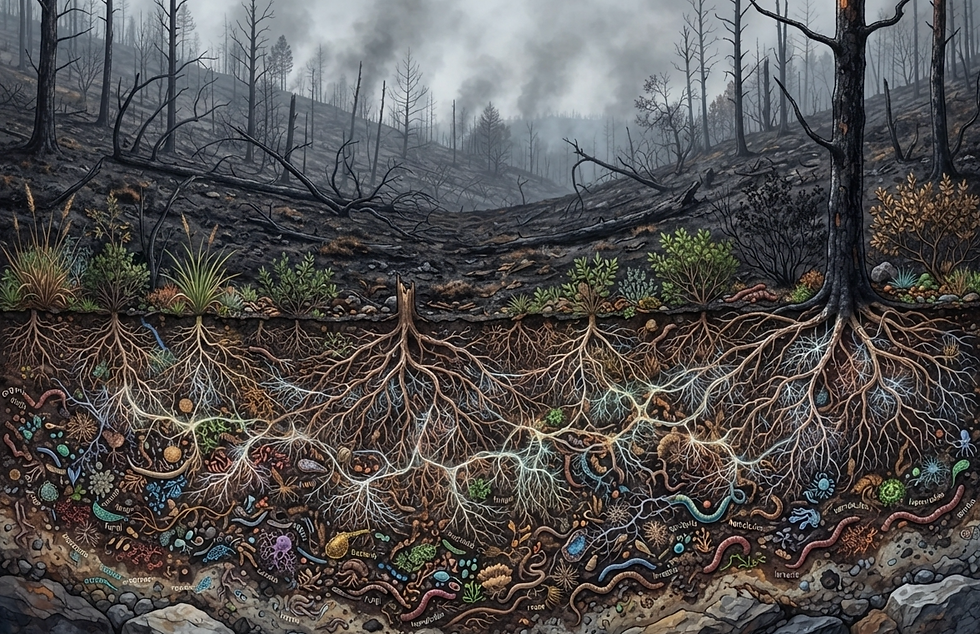
These days, wildfires are everywhere, leaving a trail of destruction in their wake. As in this image, what's above ground appears blackened and burned. Although a few sprigs of green appear in the foreground, ash, charcoal, and smoke stretch as far as the eye can see in the background. While forests all over the world are aflame, fires are also erupting closer to home, for example, in our politics and in our emotions, as we see what’s happening in the newsfeeds and in our neighborhoods.
Meanwhile, underground, it’s a very different reality. Even amid the most violent firestorms, all is well underground. The roots are unharmed, entangling with other roots, sinking deep, and connecting to the mycorrhizal network that thrums with life. Nearby, countless bacteria, fungi, protozoa, nematodes, earthworms, and insects scurry by, doing what only they can do to keep their beloved ecosystem vibrant, balanced, and whole. How can we tap into this deep wellness? Can we learn to rest and root here? Could this become our refuge in the storm?
For most of the past two million years, our human ancestors were as seamlessly and indivisibly part of the natural world as trees in a forest. Only in very recent human history has the separation from nature that we now find ourselves in occurred. While historical developments, such as learning to cultivate our own food and advancing technology, have had countless benefits, they have also fed a dangerous delusion: that we humans are somehow superior and separate from the rest of the natural world, and that, in Joanna Macy’s words, we only need the living Earth as “a supply house and a sewer.”
But, it turns out, there is a simple, freely available way of coming back, in poet Mary Oliver’s words, to “our place in the family of things,” that doesn’t depend on earning it, doing the right thing, or having a particular belief system. Finding our way home to deep belonging is the most natural thing in the world. The map is already installed in our Earthling DNA, and the path there is called “nature connection.”
When we hear the phrase nature connection, we may instinctively add it to that long list of things we ought to be doing but aren't—another skill to develop, another practice to maintain (which we don’t have time for!). But this framing misses something essential. We are already, indivisibly and inseparably, one with the natural world. We have never been disconnected. Rather, we’ve been trapped, along with countless others, in a collective bubble of separateness. Nature connection practice pops this bubble. Nature connection practice is an effortless and beautiful way of remembering, of “re-membering,” of realizing, to paraphrase Thich Nhat Hanh’s term, our “interbeingness,” and of experiencing how we and all our relations, human and more-than-human, “interare.”
Here is a simple nature connection practice that you can try next time you step outside:
Begin by turning your awareness toward a being or process in the more-than-human natural world: a breeze, a butterfly, a blade of grass, a stone held in the palm of your hand
Consciously bring awareness to seeing, or hearing, or touching, or smelling, or tasting, and—please note: this is the “key” instruction- rather than labeling or interpreting, open the sense doors wide, and, in Irish poet and philosopher John Moriarty’s words, “let nature happen to you”
And, as soon as you notice your mind has been carried away by thoughts, relax, let go of the thought, and allow your awareness to drop back into your body and into the wide-open door of seeing, hearing, touching, smelling, tasting (whichever sense-door you’re working with), and simply let everything be…
When we do this, something ancient and alchemical happens. Ancient neural pathways, dormant for centuries, perhaps millennia, begin to reawaken. These pathways are indigenous to us in the deepest sense: part of our inheritance as earthlings, woven into our human ancestry from the very beginning. As they spark back to life, the quality of our perception shifts. Colors are brighter. We hear right through the sirens and traffic noise to the buzzing of bees moving through clover, to the rustle of dry grass in the wind. Something fundamental has realigned. We have come home. We are standing again on sacred ground. We can rest a while.
Mindful Heart Programs' Upcoming Nature Connection Retreat |
What: Nature as a Field of Care and Source of Deep Resilience, with MHP faculty When: Friday, Oct. 16 – Sunday, Oct. 18, in-person only Where: Sedgwick Reserve, Santa Ynez Valley, California, USA About This Retreat Michael Kearney will lead the weekend retreat with co-facilitators Radhule Weininger, Andrew Smyth, Karen O’Hara, Miranda Field, and Peter Moreno. We regret that Shamanic Elder Tom Pinkson will not be able to join us as originally planned, but the theme, curriculum, and spirit of the retreat remain the same. The land itself will be our teacher, and we will learn nature connection and other meditative practices that help us to listen deeply to its wisdom. The Sedgwick Reserve is a UC Santa Barbara research center on the east side of the Santa Ynez Valley. The retreat is designed to help us build deep resilience by coming into oneness with the natural world on these picturesque, sacred lands, which the Chumash Nation has cared for for countless generations. During the retreat, we will address the question, “How can we stay present, open-hearted, and engaged in a world of overwhelm and burnout?” Self-care, as we usually think about and practice it, is simply not enough in the face of the challenges and escalating crises coming our way every day. We need something more; we need “deep resilience.” Together, we will explore what we mean by this and be introduced to a Celtic Map of deep resilience and two complementary, synergistic approaches: The Earth Path of nature connection and The Sky Path of non-dual meditation. Participants will be invited to bring a question to the retreat that has been on their heart, but they have not been able to answer. This may concern them, someone close to them, or the wider world. They will be invited to bring this question to an outdoor “sit spot,” where they will listen deeply and let the land speak. Later, in circle, they will share stories from their sit spot and discuss ways to integrate the lessons learned into their lives. On the first evening, we will introduce John Makransky’s Field of Care practice, adapted from Dzogchen teachings of Tibetan Buddhism, and introduce two other practices for sustainable compassion during the retreat. Registration Register here. Please refer to the registration form for fees, lodging options, volunteer opportunities, scholarships, meals, cancellation policies, and other useful information. Our team will assist you with lodging selections. Questions? Contact us at mindfulheartprograms@gmail.com. Attendance will be capped at 30. |


Comments